Everest Base Camp Cho La Pass Gokyo Trek


Cloud 1 Cloud 1 Cloud 1 Cloud 1 Cloud 2
destination Everest
duration 15 Days
grade Moderate
start/end point Kathmandu/Kathmandu
region Everest
max altitude 5420m
group size 2-12
meal All inclusive
activity 5-6 Hrs
accommodation Tea House
season Autumn/spring

Everest Base Camp Cho La Pass Gokyo Trek

The Gokyo Cho La Pass Everest Base Camp Trek will take you to the famous town of Namche Bazaar, Tengboche Monastery, Gorakshep, and Everest Base Camp (EBC). The highlight of this trek is a visit to the Gokyo Lakes via Cho La Pass (5,330m). There are some long days on the trail of between 8 to 9 hours. Most days are usually between 5 to 6 hours long. 

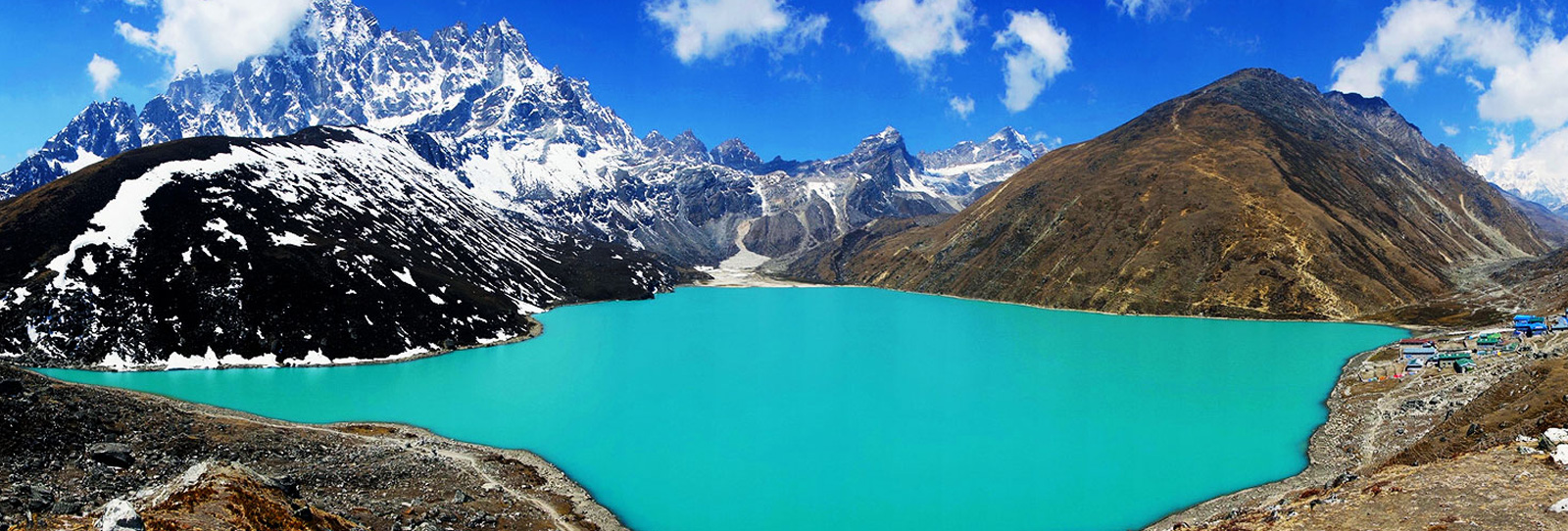
This trekking adventure begins with a short scenic flight to Namche Bazaar followed by a trek to Syangboche for your first close-up of Mt. Everest, Lhotse, Ama Dablam, and Thamserku. You will also visit Khumjung Village and the Khumjung Hillary School built by Sir Edmund Hillary (New Zealand climber along with Tenzing Sherpa Norgay) who jointly conquered Everest in 1953. The trails pass through rhododendron and pine forests and across alpine pastures where yaks graze. Along the way you will pass many chortens and see numerous Tibetan flags fluttering in the breeze. From Ngozumpa Glacier you will climb up to the turquoise blue Gokyo Lakes.

A highlight of this trek is a hike up to Gokyo Ri (5,357m) from where you can view Mount Everest, Cho Oyu, Lhotse, and Makalu. Before crossing the high Cho La Pass we will spend time acclimatizing at Namche Bazaar. After crossing the pass we head to Gorakshep, Everest Base Camp, and Kalapatthar – well known for its impressive views of Mt. Everest. 

Uma Holidays Travel & Tours will take care of all permits, meals and accommodation on the trek.

ITINERARY

Expand All
This morning you will be picked up from your hotel and taken to the domestic terminal of Kathmandu airport for your flight to Lukla – about 35 minutes. You will enjoy spectacular views of the Himalayas on your way to Lukla. Your trek begins as we pass a Kani (ceremonial gatehouse) before the trail descends and then climbs above Kyangma Village with its large Gompa (monastery). We then continue on to Chheplung Village where the trail heads through a forest close to the Dudh Koshi River. We then cross the suspension bridge and then climb up and across the ridge to Ghat Village passing a school, Mani walls, Chortens and prayer wheels. Not much further is Phakding.
This morning we head out on the trail and cross several suspension bridges over the Dudh Kosi River before coming to Tok-Tok, Benkar, and Monjo villages and then to the entrance of the Sagamartha National Park where you will be asked to produce your trekking permit. We then trek along the river bed for a few hours and after crossing the last Hillary suspension bridge we have a steep ascent to Namche Bazaar that has a good selection of restaurants, an internet cafe, pubs, a bakery, post office, ATM and banks.
Namche Bazaar is a popular place to acclimatize. Health specialists strongly recommend we stay active during this acclimatization period. From Namche Bazaar it is an easy and short trek to Everest View Resort, Thame, or Khunde. You may also choose to explore Namche Bazaar. the main hub of the Everest (Khumbu) region that has government offices and a colorful and lively market each Friday evening and Saturday. Your guide will also take you to the Tourist Visitor Centre close to the headquarters of the Sagamartha National Park where there is a display of relics related to the first mountaineers to climb Everest. You will also get an insight into the Sherpa culture and find out about the wide-diversified plant and animal life of this region.
The trail begins with a steep ascent from the valley floor passing through rhododendron, juniper and large conifer forests – alive with their fragrant odor. The trail then goes via Yak Kharka (meaning grazing pasture for yak) and various Sherpa villages. Along this section, you will enjoy some exciting views of Khumbu La Pass and Tengboche.
This morning we descend on a 3 to 4-hour trek along a trail passing through forests and then cross the Imja Khola (river). We will pass through the village of Pangboche, memorable for its fields enclosed by rock walls. We will stay overnight at Dingboche.
This morning we have a relatively easy trek and along the route have stunning views over the snow-clad mountains – especially Ama Dablam and Island Peak. We will then head down the valley to Dingboche for the evening. In the late afternoon, we can expect some strong winds in the region.
Today on the trail we pass numerous Chortens (Tibetan shrines & tombs) and after 1.5 hours we come to the village of Thugla (4600m) where we will stop for lunch at its tea house. We then head to some towering peaks, such as Mt Pumori (7161m) and Mt. Nuptse (7861m) before coming to Lobuche Village (4940m). We then follow the trail through a wide valley before arriving at Thukla – after passing the Pheriche Aid Post (4371m). The aid post is only manned during the peak trekking season. We then descend to the yak pastures of the small settlement of Lobuche.
The trail to Gorakshep is initially quite easy but slowly becomes more difficult. On the trail, we have some awesome views of several massive peaks, such as Mt. Everest, Nuptse and other mammoth peaks. We cross a moraine before coming to Gorakshep, one of the world’s most isolated and highest settlements. After stopping for lunch we trek toward EBC along a trail beside the Khumbu Glacier. The trail around the glacier takes around 1.5 hours before we come to EBC (5360m). From EBC we can see the treacherous Khumbu Glacier with its dangerous crevices. We then return to Gorakshep for the night.
In the early hours this morning, we will ascend to probably the finest viewpoint in Nepal. You will have time to watch in awe at the sunrise on the sensational Himalayan ranges, taking in the unique views as the sun rises over the mountains. We will then head back to Lobuche for breakfast and then two hours later will come to Dzongla where we will stay overnight.
We head out in the early morning from Dzongla to Cho La Pass. The trek across the glacier is enjoyable - if there is not too much snow, which at times can make it impossible to cross. From the pass, we head down to Thagnag Village for an overnight stay at a tea-house.
The trek to Gokyo is about 4 to 5 hours. We expect to arrive in time for lunch. We will spend the rest of the time here exploring the Gokyo Valley. We may also visit the glaciers and turquoise lakes of the Gokyo Valley. We will also have some amazing views of Mt. Everest, Cho Oyu, Lhotse Makalu, and other monumental snow-covered peaks.
We have a hard day on the trail as we climb to the summit of Gokyo-RI. Once at the top you will have some marvelous views back down over the Gokyo Valley, the Ngozumpa Glacier and broad views of the Khumbu Himalayan snow-covered peaks. We will then head down to Dole for the night.
Today we head out on the trail from Dole to Namche Bazaar that will take around six hours. On the trail, we will come to Khumjung Village at the base of Mount Ama Dablam. Lastly, we come to Namche Bazaar where we will stay overnight.
We have a long 7-hour trek today as we head to Lukla. Fortunately, it is mostly downhill with sections of flat ground. There are spots of rocky ground to cross that will necessitate you to watch your footing. We continue and then leave the Sagamartha National Park before coming to Lukla where we stay the night.
This morning we leave on a flight back to Kathmandu. Most flights are in the morning due to the stronger winds that occur later in the day. At Kathmandu, you will be taken back to your hotels. You can spend the day sightseeing or shopping in the narrow streets of Thamel. You may wish to enjoy the evening over a few drinks to celebrate the successful completion of this amazing trek.

SERVICES

Cost Includes

  • Three meals a day (Breakfast, Lunch and Dinner) during the trek.
  • Fresh fruit every evening after dinner.
  • Trekking Lodge (Tea House) accommodations throughout the trek.
  • All necessary paper works Sagarmatha National Park Entry Permit & Khumbu Pashang Lhamu Rural Municipality fees.
  • Kathmandu-Lukla-Kathmandu flight including airport transfer and domestic airport tax.
  • A highly experience, helpful, knowledgeable, friendly , English speaking well trained, Government License holder guide with all his salary, food, drinks, accommodation, transport and insurance.
  • Strong, helpful porters with proper safety equipment and walking equipment his salary, foods, accommodation and insurance (one porter for two trekkers).
  • Comprehensive medical supplies (first aid kit will be available with guide).
  • Arrangement of Emergency Helicopter service (paid by your Travel Insurance company).
  • Use of Sleeping bags, Down Jacket, Duffel bag and Walking Poles (if you do not have your own, to be return after you complete the trip).
  • Government taxes and official expenses.
  • Oxymeter to check your pulse and oxygen saturation and heart rate twice daily (Very useful to check Altitude Mountain Sickness(AMS) symptoms) Which will ensure you trek is in the safest hands possible for all levels of trekker.
  • Assistant guide group size above 6+ person.

Cost Exclude

  • Airport pick up and drop from and to your international flight.
  • Meals and hotel whilst you are in Kathmandu.
  • Nepal entry visa on arrival at Kathmandu airport ,$50 USD for 30 days visa.
  • International airfare.
  • Your Travel and Medical Insurance(Recommended)
  • Your personal expenses.
  • All the alcoholic and non alcoholic hot and cold drinks.
  • Desserts Sweet things like chocolate, cake, pie, pudding.
  • Battery charging and hot shower during trek on the tea houses.
  • Tips for the guide and porter (Tipping is expected).
  • Excess baggage more than 15kg for Lukla flight.

EQUIPMENTS

Trekking equipment

The Following information will give you some idea about what you need to bring for the trek as the backpack for the hiking in Nepal and the gear play a vital role for the successful trip and we suggest you to have all the necessary gear for the trip and not to have unnecessary equipment/things that you will not be using for the trip and list of the gear you need for the trek are:

  • Good down Sleeping bag (Optional/we can provide one if you do not have on your own and it is to be returned after the trek.
  • Duffel or Rucksack bag to keep your all the gear and this will be carried by the porters.
  • Daypack bag for yourself
  • A down Jacket
  • Shade hat
  • Warm wool hat to cover your ears
  • A pair of lightweight warm gloves.
  • T-shirts 2- 3 pieces
  • Lightweight thermal tops.
  • Fleece jacket.
  • Fleece Wind-proved jacket (optional).
  • A pair’s nylon hiking shorts which are quick drying one
  • Underwear
  • Two pairs of lightweight long underwear.
  • Two pairs trekking pants, preferably that zip on/off at the knees so they double as shorts
  • Four pairs of liner warm socks
  • A pair of light to medium weight waterproof hiking/trekking boots.
  • A pair of light trekking shoes for camp/lodges
  • A pair sandal (Optional)
  • A water bottle.
  • Head/Torch Light.

Medicines and First Aid Kits

  • Extra Strength Excedrin for altitude-related headaches like DMX.
  • Ibuprofen for general aches and pains.
  • Imodium or Peptone besom, Flexon capsules for upset stomach or diarrhea.
  • Diamox 125 or 250mg or 400mg tablets for altitude sickness.
  • 1 small personal sized first-aid kit with blister treatments such as moleskin, band-aids, some waterproof tape, anti-infection ointments, etc.(Uma Holidays Travels And Tours company's team also provide first aid kits)

Miscellaneous but Important

  • Passport and extra passport photos (4 copies)
  • Durable wallet/pouch for travel documents, money & passport.
  • Lip care (Balm) At least SPF 20, 2 sticks.
  • Sun’s cream with SPF 40 is recommended
  • Pocket knife.
  • Water purification Iodine tablets
  • Toiletry kits and be sure to include toilet paper stored in a plastic bag, hand wipes, and liquid hand sanitizer, towel, soap, etc.

Note Regarding Itineraries:
Although we generally adhere to the schedule, the itinerary is subject to change for numerous reasons beyond our control, including weather and terrain conditions, suitable campsite availability, and the group's general fitness level. It is important to understand that our trek is logistically complex and it is not unusual that adjustments be made. Our guide will orient you each evening to the following day's plan and their good judgment is the key to the long history of successful treks that Uma Holidays Travels And Tours Pvt. Ltd.  Please remember that our ability to make adjustments as needed helps to ensure that your trek is safe and successful. Your safety is paramount.

MAP

Departures

Trip Date Duration Price Seats Left

FAQS

Expand All
Yes, you can. No matter who you are, as long as you are reasonably fit, can walk for 5-6 hours a day and trek/hike a few uphills,Umaholidays will support you to the fullest to transform your dream of standing at Everest Base Camp into reality.
The month of March to May in Spring and September to December in autumn seasons are considered the best for the Everest Base Camp Trek as the weather conditions become favorable during this time, providing you with good visibility and a suitable atmosphere for Everest Base Camp trekking.
No, there is no age limit for the trek to Everest Base Camp but, you need to be in good physical shape and have a positive attitude. We also suggest you to prior to the excursion though we suggest you to please see your doctor and obtain necessary permission and advice, as well as medications for traveling in extreme altitude prior to the excursion.
During trekking, you will be served meals in the teahouses. Typical meals are noodles, rice, pasta or potato dishes along with vegetables and egg/chicken/meat dishes. Other items mostly served as breakfasts include Tibetan, egg, pancake, bread, porridge, muesli, and toasts with peanut butter and honey
A teahouse trekking accommodation will be made for you for the Everest Base Camp trekking whereby you will be able to stay at tea house(Local lodge) and have wholesome food and net and clean comfortable bed throughout your trekking journey. This form of arrangement also allows you to carry less baggage; you can trek at your own pace and enjoy the Everest panorama on your own schedule. It is also an eco-friendly way of trekking whereby trekkers can have more contact with the local's sherpa peoples.
Most of the teahouses on the Everest Base camp trail have squat toilet facilities but recently built lodges have western-style toilets as well. Nowadays, flush toilets are also being introduced with number of increasing foreign mountaineers each year. It is highly recommended to carry your own toilet paper and other required toiletries. Hot shower facilities are available till Gorakshep. The most common type is a bucket shower, usual buckets with tap filled with hot water and placed in a shower room. Hot shower costs from US$ 4 to 15 per use and the price increases along with the elevation. Attached bathrooms and toilets are not available unless you book for a luxury lodge during the EBC trek.
What you want to wear depends on you but we suggest you wear warm clothes during the Everest Base Camp trekking. A down jacket, thermal longs and top, comfortable trekking trousers, t-shirts, fleece, windproof jacket, hat, scarf, and gloves might be useful. There are numerous trekking shops in the Thamel area of Kathmandu where you can get all of these items in both local and branded stores alike. Sherpa Expedition and Trekking may also accompany and assist you if required.
During the Everest Base Camp trekking, you will be on a long journey for which you will need two bags to keep your belongings. A rucksack/duffle bag and a day bag for personal items. Umaholidays will provide you with a duffle bag (which is need to refund after the trek) that you can use throughout your entire journey and even afterward. These bags are durable and hence perfect for any kind of trekking journey. While the duffle bag will be carried by the potters, you will have to carry a day bag on your own. A day bag is a small backpack that has enough room for everything you will need on a day hike such as lunch, water, extra clothing and perhaps a few personnel items like camera, battery chargers, etc.
S If possible, we suggest you bring your own equipment. However, sleeping bags and down jackets will be provided to you by Umaholidays. With regards to trekking poles, if you are used to walking with it then take them with you, as you will probably find them useful especially on the way down. They are not essential though and the walk is manageable without them. It is mostly a personal preference. If you prefer to take the trekking poles with you on the trekking then you can either bring your own pole or buy it from numerous options available in Kathmandu itself.
Yes, if you have a bag of extra clothing for when you return from the trekking, you will be able to store it safely in Kathmandu Umaholidays office. The storage facility is provided by most hotels and lodges in Kathmandu or you can also store it in our office for the duration of the trekking.
Our itinerary has been specially tailored to prevent any kind of AMS (Acute Mountain Sickness) while moving up to higher altitudes. Normally, altitude sickness starts from 3,600 meters and above. You will be trekking at a relatively slow and gradual pace as part of the acclimatization process. Cut off caffeinated, alcoholic and smoking items. Drink at least 4 liters of water a day. Trek slow. Don't skip the acclimatization days. Better to continue with Diamox (if any symptoms show up). Drink Garlic Soup. In the higher elevation, there is less oxygen in the air and this is more so while crossing high passes. Our expert guides will advise you on how to avoid AMS and treat it when/ if required.
Make sure to have both medical and evacuation insurance before coming to Nepal for Everest Base Camp trekking. You should be careful in choosing a policy while traveling to a Himalayan country like Nepal as some insurance companies may make special exceptions for adventure travel. If you are confused about the insurance, please inform us and we will help you. It is usually better to arrange your insurance in your country before travel.
The trekking will be 5-7 hours a day depending upon the landscape and destination.
It takes 6 to 14 days to reach Base Camp depending upon the mode of transportation and packages of Umaholidays offers.
We at Umaholidays Team always have the safety, comfort, and satisfaction of our valued customers as our foremost priority at all times, and we assure you a wonderful and unforgettable time with us in our beautiful country. Sherpa team members of Umaholidays will be carrying all the necessary gear, equipment, and first aid kits and they have extensive first aid training. If a trekker falls sick on high altitude, the leader will decide whether to continue the trek. In case of emergency, Umaholidays have a rescue helicopter to bring you back from the higher elevation. Moreover, Umaholidays also provides oximeter to monitor the oxygen level at high altitude and offers regular health check-up facilities. We at Umaholidays Team always have the safety, comfort, and satisfaction of our valued customers as our foremost priority at all times, and we assure you a wonderful and unforgettable time with us in our beautiful country. Sherpa team members of Umaholidays will be carrying all the necessary gear, equipment, and first aid kits and they have extensive first aid training. If a trekker falls sick on high altitude, the leader will decide whether to continue the trek. In case of emergency, Umaholidays have a rescue helicopter to bring you back from the higher elevation. Moreover, Umaholidays also provides oximeter to monitor the oxygen level at high altitude and offers regular health check-up facilities.
You can either trek on foot or by a helicopter. Umaholidays offer exciting and reasonable Helicopter trek to Everest Base Camp for 5 days and 10 days. Umaholidays can also customize your tour as per your necessity.
The flights are usually regular between September and May. But due to high altitude, bad weather and unforeseen technical issues, you may experience a delay or cancellation of the flight. On the occurrence of such events, Umaholidays charter a helicopter to make sure you are on the safe schedule either for a trek or for your flight back home which would cost extra charge as an unexpected event. However, if the visibility is less than 1,500 meters, it is unable to operate helicopter facilities and Umaholidays will reschedule the flight.
Umaholidays will provide one porter for two trekkers to carry 20 kgs of luggage (maximum 10 kg for each trekker). Please be sure your porters are not overloaded because they do not carry only your equipment but also lift your spirit to reach new heights, and your love, affection, and generosity can be the reason for them to work hard to take you to your destination. However, the weight limit on flights to the Everest region, basically to Lukla is a total of 10 kgs and you need to pay an extra amount per kg for the excess baggage. Umaholidays pays up to 5 kgs of extra baggage making your total to 15 kgs with your hand bag.
Garlic soup is a must while trekking. Umaholidays recommend trekkers to drink green tea, lemon tea, hot lemon ginger tea and drink at least 2-4 liters of water a day. However, it is better to avoid alcohol and alcoholic beverages, caffeinated items, and hot-chocolates at high altitude.
Umaholidays won’t recommend non-veg items because the meat in such places may not hygienic and healthy. Umaholidays also encourage to avoid dairy and cheesy items and strongly suggest not to consume them during the trek. So, our packages are suitable for both vegan and vegetarians.
Your guide and porters are a big reason why you got a chance to feel something very few can have. Apart from guiding and carrying your necessities and being mindful of your safety, they want to see you happily succeeded more than anyone like family and help you successfully complete the trek safely. So, your tips reflect gratitude towards them. So, tipping is a recommended culture for porters and guide in Nepal as a gesture of thankfulness.
Umaholidays will introduce dozens of shops selling knock-off gear in Kathmandu. You can also barter those gears at the knock-off places but be sure you keep the receipt safely. Moreover, you can rent the needed gears if you do not want to buy them.
Yes, most guesthouses offer Wi-Fi, for a small charge. it cost USD$5 per day.
Most of the tea houses/ lodges have electricity whereby you will be able to charge your iPod or camera batteries. Please note that lodges/tea houses will charge you some extra money for the services. The fee may vary from 1 USD to 3 USD per hour.

We Offer Group Discount

No. Of People Price Per Person
1 Pax USD 1,600
2 Pax USD 1,550
3 Pax USD 1,500
4 - 6 Pax USD 1,450
7 - 12 Pax USD 1,400
13 - 18 Pax USD 1,350
19 - 24 Pax USD 1,300
  • Best Price Guarantee
  • Hassle-Free Booking
  • Team of highly experienced Experts

All Inclusive Cost

USD 1,600

Per Person

BOOK NOW QUICK ENQUIRY

Latest Traveller’s Reviews

Travel experiences of our clients who recently returned from their trips.

No Reviews yet.
Be the first one to review.

Write Your Review

People Considering This Package Right Now
Subscribe and Win a Free Everest Trek!